Search
Kizárt szavak
Tiltott szavak
- cialis
- viagra
- php
- sql
- html
- https
- http
- chr
- script
- sex
- porn
- sexmassage
Alternatív kifejezések
- =
1. Valley of Herbs
Last modification: 2025. November. 26. 09:58
Herbs become teas and infused oils, fruits turn into dried snacks and pure juices — all crafted from natural ingredients using modern methods. Step into their “witch’s kitchen” and discover how nature’s gifts are transformed.
Találati relevancia adatok
Tárolt adatok:
The Life-Giving Winds of the Ice Age: How Loess Shaped the Land
Did you know that Transdanubia’s rich, golden soils are actually a gift from the winds of the Ice Age? Loess isn’t just a dry geological term — it’s an ancient natural recipe that gave rise to some of the most fertile soils in the Carpathian Basin. Where vineyards grow today and birds nest in loess cliffs, strong winds once carried yellow dust across the landscape — for thousands of years. Learn how this unique sediment shaped the land and why loess is still essential for sustainable farming today.
What Is Loess and How Did It Form?
The term loess comes from the German word lose, meaning "loose." Loess is a fine-grained, yellowish sediment that was deposited during the Pleistocene epoch (2.58–0.01 million years ago), particularly during glacial periods. It formed in periglacial environments south of the great Scandinavian ice sheet — cold, dry landscapes with little or no vegetation.
The dust was carried by strong Ice Age winds from floodplains and barren steppes, and slowly accumulated over tens of thousands of years. Eventually, calcium carbonate cemented these layers into loess, which developed characteristic vertical fissures.
It’s important to note that the Pleistocene wasn't a single “Ice Age,” but a period that included alternating cold and warm phases — some even warmer than today.
Loess and the Landscape
Loess gave the Carpathian Basin — especially Transdanubia — its distinct terrain.
Steep loess cliffs (sometimes up to 10 meters high), caves that provide nesting sites for bee-eaters and sand martins, centuries-old sunken roads carved into hillsides, and exposed root systems are all part of the landscape’s geological legacy.
Together, they define the unique character of this region — shaped by time, wind, and stone.
Fertility and Water Retention
Loess-rich areas have produced some of the most fertile soils in the region. Many local producers farm on land that sits atop loess. This creates an excellent foundation for agriculture — not just because of the high humus content, but also because loess has outstanding water-holding capacity. Its vertical pores allow moisture to penetrate deeply and remain in the soil, even during dry periods.
A Modern Echo — Dust from the Sahara
Interestingly, the fine Saharan dust that now reaches Central Europe more frequently can be seen as a modern counterpart to loess-forming material. It’s a reminder that the powerful natural forces that shaped the land long ago are still at work today — just on a different scale.
2. Gallery
Last modification: 2023. January. 24. 11:12
Találati relevancia adatok
Tárolt adatok:
3. Gallery
Last modification: 2019. March. 28. 09:34
Találati relevancia adatok
Tárolt adatok:
4. Programmes for all the four seasons
Last modification: 2024. September. 03. 13:02
Találati relevancia adatok
Tárolt adatok:
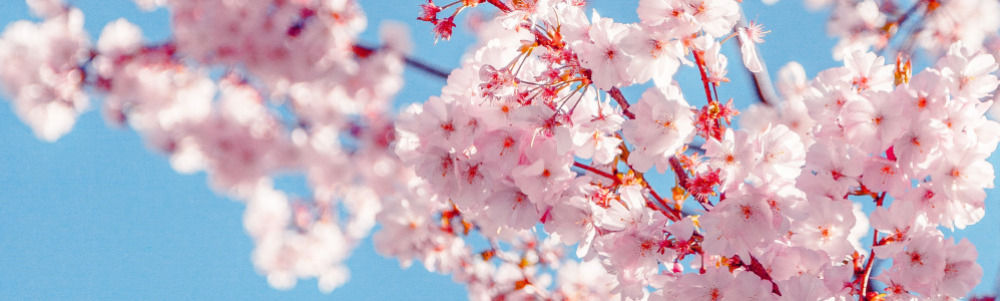
Why spring? Because spring is about renewal, beauty, health, and life itself. Because the grass is greener, the weather is warmer, the evenings are longer and the water of Lake Hévíz is getting hotter and hotter every day. Spring is the joy of life, the season of birth and rebirth of the town, the season of the Happy Peacetimes Festival, the celebration of mothers, women, children and faith. The hiking boots, bicycles, e-bikes, scooters are taken out again. With renewed energy, you get out in nature and can’t have enough of the smell of freshly cut grass. You enjoy the first rays of the sun and have the incredible experience of swimming on the shores of a hot-water lake, even in April. What to do here? Bathe in the 30°C thermal lake before the summer beach season, recharge your batteries in nature, either during an easy hike or a bike ride. Climb to the castle ruins, the lookout towers and enjoy the magnificent view of Lake Balaton, Kis-Balaton, or even in the mating dance of waterfowl. Or pamper yourself in the spa, recharge your batteries, exercise, change your lifestyle, go on a diet, treat your skin or relieve the aches and pains in your stiff limbs with the help of skilled hands because it has been a long winter. Take advantage of every long weekend to get away from the routine of everyday life.

Why summer? Because in summer the area is full of life, fun and programmes. Everybody goes to the pools or the beach at the lake in Hévíz or to the best beaches of Lake Balaton /Keszthely, Gyenesdiás, Vonyarcvashegy, Balatongyörök/, or, in the case of bad weather, to the adventure baths of the area /Kehidakustány, Zalakaros/. Because festivals in the villages, knights’ tournaments in the castles and summer theatre plays in the park of the palace offer you unforgettable experiences almost every day. This is the time of beer, wine and gastro festivals, running and cycling races, music and dance festivals. And anyway, as the song goes: "The sun is shining, don't be sad....” What to do here? Enjoy the summer and your holiday, discover the best places in Hévíz and the surrounding area. It's the time of active relaxation, festival atmosphere, fun, children's laughter and clinking of glasses in the evening. Come and join in the fun and indulge in a variety of adventures. You won't be bored, however, you can decide to relax in the very pleasant, hot water of Lake Hévíz all day.

Why autumn? Because autumn is full of the vibes of summer, of the sun under your skin, of wonderful flavours, smells and colours. It is also full of the praise of wine, grapes, pumpkins, roast goose. Every warm day of autumn is a gift, a closure and a preparation. Autumn is quality, desire, and sensuality. Autumn brings time and attention. It encourages you to enjoy every moment while you can, but slowly, with pleasure because it quickly slips away. What else could it be about but gastronomy, the harmony of flavours, scents and colours, Variations on WINE wine dinners and Martin's Day, about introspection, caring. What should you do here? Enjoy the beach season that lasts until October here when the water of Lake Hévíz still retains the warmth of summer. Enjoy the culinary events of autumn and early evening concerts of popular music on a cosy terrace or at the Egregy wine hill. Take one last boat ride in the sunset on Lake Balaton, run, jog, walk, cycle along the promenades rustling with falling leaves. Recuperate, relax, slow down, be a little selfish and take care of yourself.
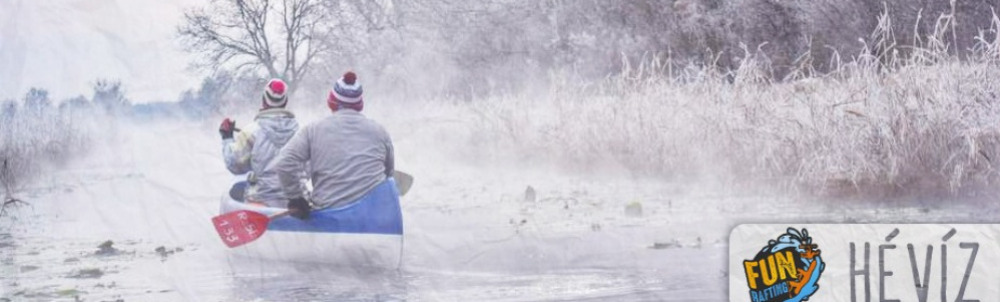
Why winter? Because winter is full of lights, flavours, atmospheres, intimacy. And also with Advent markets, Christmas concerts and, of course, New Year's Eve street parties. Winter is wonderful, especially when it's white. When you canoe in the snowfall on the steaming Hévíz stream, when the frozen Balaton becomes a seemingly endless skating rink, when you swim in the steaming Hévíz Lake while everything around you is frosty and white. The winter is full of warmth: sit in the thermal waters of the pool, enjoy a sauna session, have a hot Christmas drink between your hands. And winter is also full of romance, days spent together, silence and love. And if you stay until the end of winter, it's full of fun and happiness too, when we get bored of it and drive it away at the carnival. What should you do here? Enjoy the peace, the lights, the delicious flavours. Indulge yourself and your partner with massages, relax in the sauna sessions, unwind with the power of steam. Take a swim in the Hévíz steam in winter, because you can't do it in summer, and go to the cinema in the evening instead of watching TV. Take part in gastronomic events, but don't miss the magnificent view of Lake Balaton in winter from the highest tower of Szigliget Castle. Winter is all about you. It's about you and your loved one. Surprise her/him.
5. Cserszegtomaj Delights
Last modification: 2025. November. 26. 09:41
Pickles, fermented vegetables, smoky zakuska, homemade jams, and roasted hazelnuts — all crafted from homegrown produce, free of additives, just like grandma used to make.
Találati relevancia adatok
Tárolt adatok:
Imagine a vast body of water — over 1,000 meters deep and more than 400 times the size of Lake Balaton — once rippling across this land. The story of the Pannonian Lake is not just a fascinating chapter of geological history, but a legacy that continues to shape the region: it left behind mineral resources, fertile soils, and even inspired legends. Discover how an ancient lake transformed Transdanubia — and why its impact is still felt today.
An Inland Sea for Millions of Years
At its greatest extent, the Pannonian Lake covered an enormous area, far surpassing the size of today’s Balaton. For millions of years (approximately 12 to 8.5 million years ago), it dominated the region. As surrounding mountain ranges gradually rose, the lake became cut off from the world’s oceans. Its water slowly turned fresh, and its basin began to fill with sediments. Because of its isolation, the lake developed a unique ecosystem with many endemic species.
The Lake Didn’t Appear Overnight
The Pannonian Lake didn’t simply “appear” in the Carpathian Basin. Its formation was the result of millions of years of tectonic activity and shifting climate. It emerged as an independent, enclosed body of water — no longer connected to the open seas.
Deep Waters, Varied Shores
In some areas, the lake reached depths of over 1,000 meters. Elsewhere, shallower zones supported lagoons, river deltas, and small, isolated lakes. During high water periods, rocky shorelines formed along the mountain fringes — traces of which can still be found today in the Keszthely Hills and the Mecsek Mountains.
The Lake’s Retreat — and Sediment Legacy
Despite its size, the lake was eventually filled in by immense volumes of sediment, carried mainly by rivers flowing from the Alps and the Carpathians. Over the course of 6.5 million years, it gradually disappeared from the landscape.
What did it leave behind?
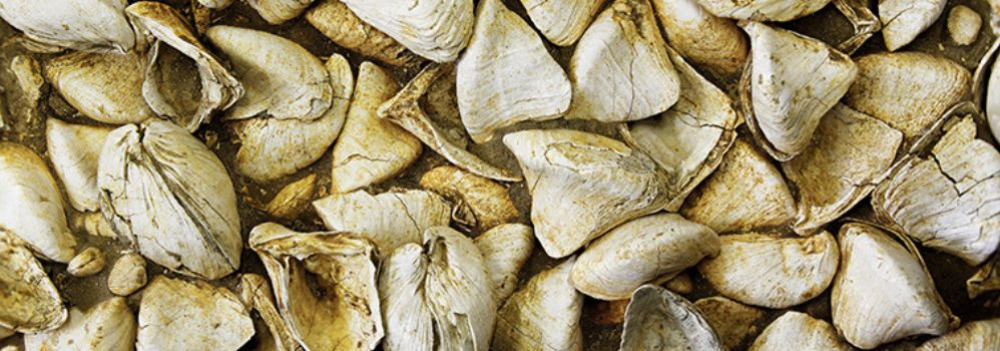
Its sediments — composed mostly of sand, clay, and fine silt — became the so-called “Pannonian formations,” which today hold key mineral resources (such as petroleum) and aquifers. These formations define much of the surface geology of Transdanubia, including the Zala Hills.
Fertile soils later formed on the laminated silty and clay-rich deposits of the Somló Formation. Even the legendary “Tihany goat’s hoof” fossils — actually worn shell fragments of the Congeria ungulacaprae mollusk — can still be found embedded in these ancient layers.
The Final Lakes and a Gradual Goodbye
Because most of the sediment entered from the northwest, north, and northeast, the lake slowly retreated toward the south and southeast — as if it were “withdrawing” from what is now Hungary.
Small remnant lakes persisted for much longer in areas of present-day Slavonia (Croatia) and northern Serbia, but due to their different scale, character, and fauna, they are not considered true successors of the ancient Pannonian Lake.
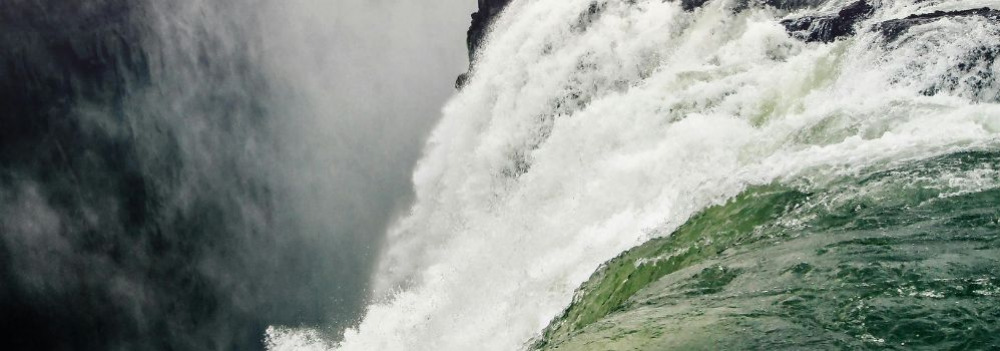
About 10,000 years ago, rapid climate warming triggered a cascade of natural responses: torrential floods, landslides, and intense rock weathering. The landscape we walk on today was not shaped over mere centuries, but by the dramatic forces of climate and water, working together. Did you know that the Zala Valley floor is made up of sediments deposited by a kind of "river of time"? Discover how the Earth’s surface became one of the most sensitive indicators of climate change.
Climate Change: Not Just a Modern Phenomenon
We often associate climate change with contemporary issues, but Earth’s climate has shifted many times throughout its history — sometimes quite rapidly. Within large-scale climatic cycles, alternating periods of warming and cooling have long been part of the planet’s natural rhythm.
When Climate Changes, Everything Reacts
A change in climate sets off a chain reaction of environmental processes. It’s not just animals and plants that respond — so does the landscape itself.
Around 10,000 years ago, as the climate warmed significantly, rainfall became more intense.
More rain meant more erosion: stormwater began washing away sediment from hills and valleys into riverbeds. The rivers, now carrying more water and more sediment, flooded more often and spread these materials across the landscape.
Shaping the Terrain
This had a major impact on topography: the land surface became more fragmented and dynamic. Warming temperatures also sped up chemical and physical weathering, breaking down bedrock and helping fertile soil layers to develop.
In short, natural geological processes that had long been underway suddenly accelerated — and reshaped the surface of the land.
Young Sediments at the Base of the Slopes
Today, in many areas of the region, the lower slopes and valley edges are coated with sediment — debris washed down from higher ground, largely within the last 10,000–20,000 years. In the Zala Valley, for instance, these deposits have spread so far that they now reach the center of the valley floor.
The original bedrock source of these sediments varies: in Zala, it’s typically Pannonian sand (Somló Formation), while in the Keszthely Hills, marine-origin carbonates dominate — mostly dolomite, with some limestone. These sediments now appear as fine gravel, pebbles, or coarse sand, quietly recording the environmental changes of the recent past.
6. GM Design
Last modification: 2025. November. 26. 09:57
In the heart of the “capital of Lake Balaton,” a small artisan workshop in Keszthely crafts handmade chocolates from premium Belgian ingredients. One of their most unique creations features sea buckthorn.
Találati relevancia adatok
Tárolt adatok:
7. Margit Kreiner
Last modification: 2025. November. 26. 10:32
It’s not often you get to taste quail eggs — especially ones marinated in aromatic olive oil. Another must-try specialty is the wild garlic pesto, an irresistible highlight of the farm.
Találati relevancia adatok
Tárolt adatok:
The Life-Giving Winds of the Ice Age: How Loess Shaped the Land
Did you know that Transdanubia’s rich, golden soils are actually a gift from the winds of the Ice Age? Loess isn’t just a dry geological term — it’s an ancient natural recipe that gave rise to some of the most fertile soils in the Carpathian Basin. Where vineyards grow today and birds nest in loess cliffs, strong winds once carried yellow dust across the landscape — for thousands of years. Learn how this unique sediment shaped the land and why loess is still essential for sustainable farming today.
What Is Loess and How Did It Form?
The term loess comes from the German word lose, meaning "loose." Loess is a fine-grained, yellowish sediment that was deposited during the Pleistocene epoch (2.58–0.01 million years ago), particularly during glacial periods. It formed in periglacial environments south of the great Scandinavian ice sheet — cold, dry landscapes with little or no vegetation.
The dust was carried by strong Ice Age winds from floodplains and barren steppes, and slowly accumulated over tens of thousands of years. Eventually, calcium carbonate cemented these layers into loess, which developed characteristic vertical fissures.
It’s important to note that the Pleistocene wasn't a single “Ice Age,” but a period that included alternating cold and warm phases — some even warmer than today.
Loess and the Landscape
Loess gave the Carpathian Basin — especially Transdanubia — its distinct terrain.
Steep loess cliffs (sometimes up to 10 meters high), caves that provide nesting sites for bee-eaters and sand martins, centuries-old sunken roads carved into hillsides, and exposed root systems are all part of the landscape’s geological legacy.
Together, they define the unique character of this region — shaped by time, wind, and stone.
Fertility and Water Retention
Loess-rich areas have produced some of the most fertile soils in the region. Many local producers farm on land that sits atop loess. This creates an excellent foundation for agriculture — not just because of the high humus content, but also because loess has outstanding water-holding capacity. Its vertical pores allow moisture to penetrate deeply and remain in the soil, even during dry periods.
A Modern Echo — Dust from the Sahara
Interestingly, the fine Saharan dust that now reaches Central Europe more frequently can be seen as a modern counterpart to loess-forming material. It’s a reminder that the powerful natural forces that shaped the land long ago are still at work today — just on a different scale.
8. LídRind Porta
Last modification: 2025. November. 26. 10:34
At Lídrind Porta, every bite comes from home-raised cattle, crafted naturally and by hand, without additives.
Találati relevancia adatok
Tárolt adatok:
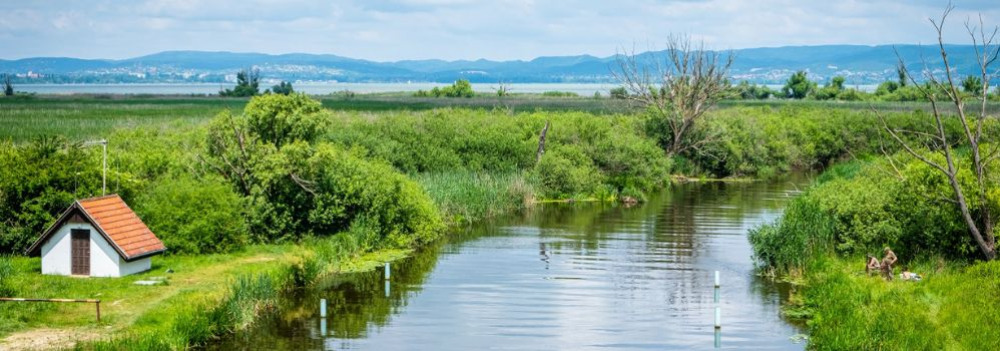
Did you know the Zala River once flowed into the Drava and only later “found” Lake Balaton?
The history of western Hungary’s water systems is not just a fascinating geological puzzle — it reads like an epic of Earth history: riverbeds shift, rivers “consume” one another, and even Lake Balaton doesn’t enter the scene until the final chapter. Discover how nature reshaped this landscape stroke by stroke — and how the Zala became Balaton’s most vital source of water.
The Quaternary Period and the Power of Landscape Formation
What sets the Quaternary Period (2.58 million years ago to the present) apart from earlier geological epochs is that the surface-shaping processes of this time — and the landforms they produced — continue to define our geographic environment today.
Pleistocene Changes: Riverbed Migrations and Terraces
One of the most pivotal surface processes during the Pleistocene (2.58 to 0.01 million years ago) was the migration of riverbeds and the formation of terraces and alluvial fans. These changes were closely tied to the slow retreat of the Pannonian Lake, which once filled much of the Carpathian Basin (see also: The Legacy of the Ancient Pannonian Lake).
The Ancient Danube Moves West
The early Danube initially flowed westward across what is now western Hungary, draining into the retreating Pannonian Lake. This westward course likely remained until the early Pleistocene.
A River’s Great Turning Point
The most dramatic hydrological change in the Carpathian Basin occurred between the Pliocene and Pleistocene: the formation of the Danube’s Visegrád Gorge (today’s Danube Bend), which diverted the river toward the center of the country and what is now the Pest Plain.
This shift profoundly affected all its former western tributaries — including the Zala.
The Story of the Zala: Migration and Capture
The river system of Central Transdanubia evolved in surprising ways, and the Zala’s journey is one of its most remarkable chapters. The Rába River already flowed northeastward toward the Little Hungarian Plain. The ancient Marcal, running northward, flowed into the Rába — and into it, in turn, flowed the ancient Zala.
But nature redrew the map — using the Zala as its brush. A now-vanished river flowing from north to south (its remnants visible today between Zalaszentgrót and Zalavár) cut into the landscape through a process called headward erosion — where rivers erode backward into the terrain, much like a hot knife slicing through butter. Eventually, it cut into the ancient Zala’s valley and “captured” the river, diverting it into its own course.
A New Path — and the Birth of Lake Balaton
From then on, the Zala made a sharp turn south at Türje and — with no Lake Balaton yet in existence — initially emptied into the Drava. Later, as the depression that would one day become Lake Balaton deepened, the Zala was gradually drawn toward it.
Lake Balaton, as a continuous body of water, is only about 5,000 years old — but for millions of years before, the Zala had already been on a winding journey that ultimately made it Balaton’s primary source of water, and the most life-giving river in the region today.
9. Hiking and touring
Last modification: 2024. August. 16. 13:40
Találati relevancia adatok
Tárolt adatok:
10. Tourinform Office
Last modification: 2023. August. 02. 12:50
The Tourinform Office is the main information service provider for the visitors arriving in Hévíz; you should also pop in if you have any question or you want to make enquiries about any programs and events in the town. The Office is located in the walking street so it is within easy reach both for motorists and pedestrians. You’ll find a wide range of information publications (leaflets, promotional booklets, calendar of events, catalogue of accommodation, etc.) in the Tourinform Office.
Találati relevancia adatok
Tárolt adatok:
11. Lake Hévíz
Last modification: 2025. February. 17. 14:58
Találati relevancia adatok
Tárolt adatok:
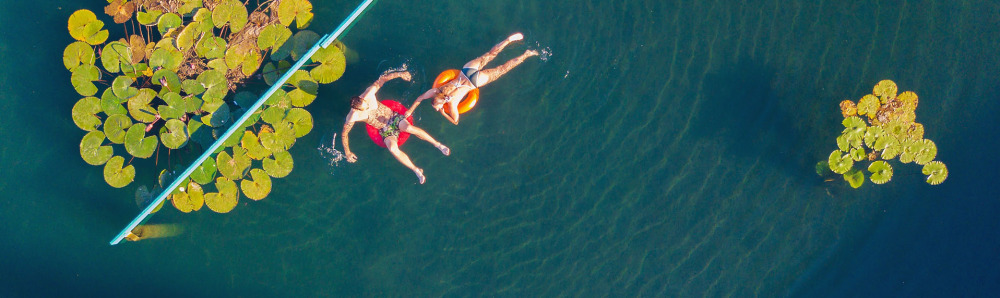
Flavius Theodosius, the emperor who was a sickly child, or the best-known legend of the origin of Lake Hévíz
According to the ancient legend about the birth of the lake and its healing powers, Flavius, a Roman boy, was brought up by a Christian nurse here in Pannonia. The boy was weak and of poor health but his father was a great military leader so the nurse prayed to Virgin Mary to help him. The Holy Virgin, hearing her prayer, caused a spring to gush forth, in the healing water of which the child was bathed every day. The hot water of the spring and the steaming mud made the child's body grow stronger and stronger. Later, the boy became the Emperor of Eastern Rome, Flavius Theodosius, who made Christianity the state religion of his empire in 391. Since then, the water of the spring has been feeding Lake Hévíz and has brought healing to many.
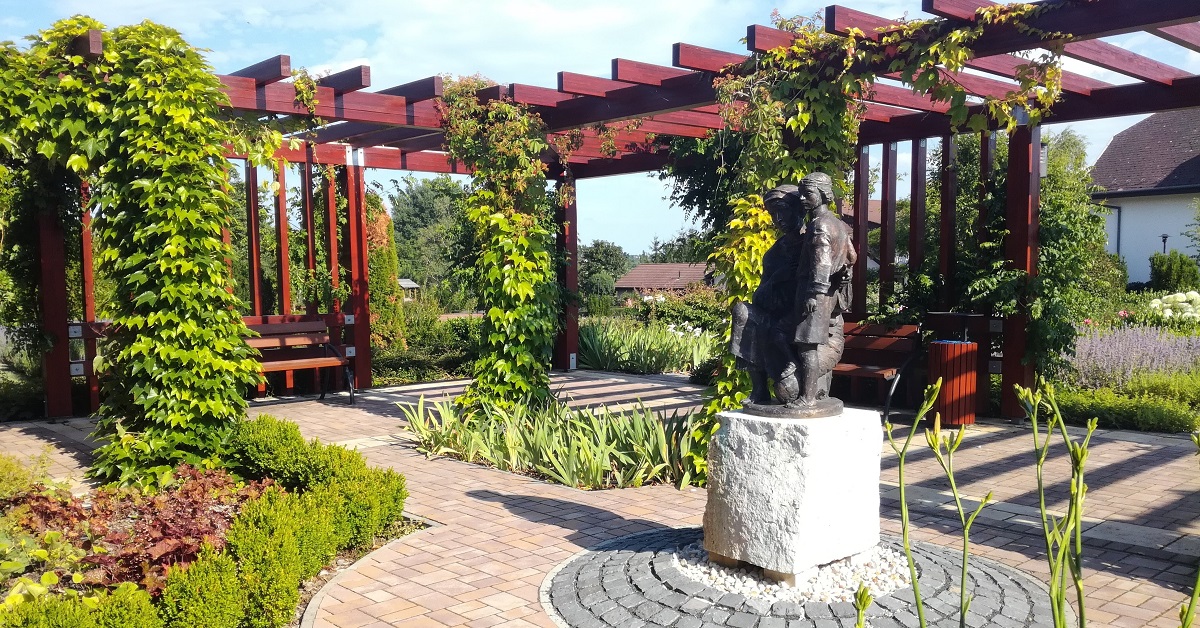
When it comes to Hévíz and the Romans, there is no doubt that there were several places in the settlement and the surrounding area where people lived in Roman times. Local excavations show that there was a significant settlement in the period of the Roman empire in the present-day Egregy district. Several finds of the Villa Rustica - or villa farm - show that the settlement was inhabited from the 1st century until the 5th century. Roman artefacts were found not only in Egregy but also in other parts of Hévíz: Roman coins, earthenware, and an altar stone of Jupiter were found in the bed of Lake Hévíz.
The formation of Lake Hévíz in reality…
Lake Hévíz was born at the same time as Lake Balaton 20-22 thousand years ago. The origin of Lake Hévíz dates back to the time when the basalt mountains around Lake Balaton and Lake Balaton itself were born. At the end of the Pannonian period, volcanoes broke up the landscape of the Transdanubian region. The first signs of postvolcanic activity were the eruption of hot springs, such as the original Hévíz thermal spring. Archaeological excavations show that people lived here as early as the end of the Stone Age. In addition, many legends are dating back to different periods about the healing properties of the water here. According to Roman remains and finds, Hévíz was already a settlement 2,000 years ago, but even more surprisingly, water samples taken upon the discovery of the spring cave suggest that the cold water from the spring is 8,000 years old, while the hot medicinal water is 12,000 years old.
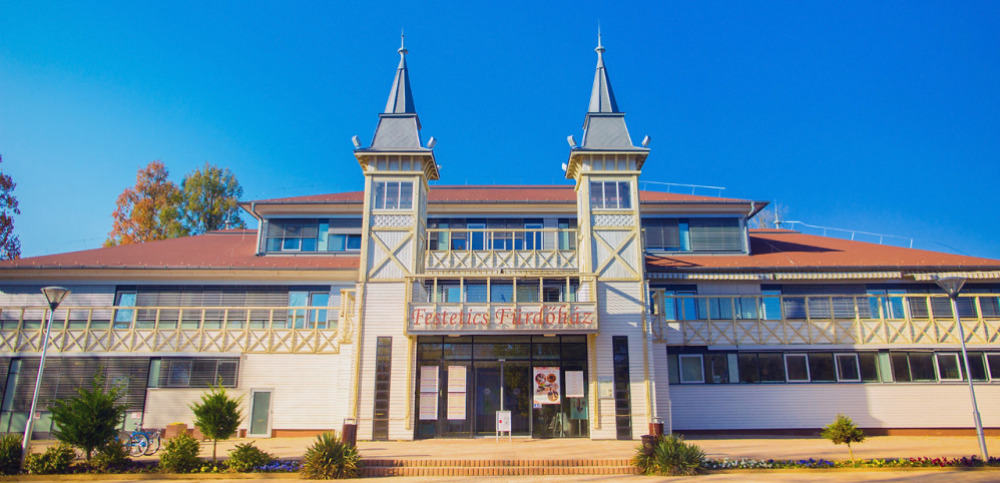
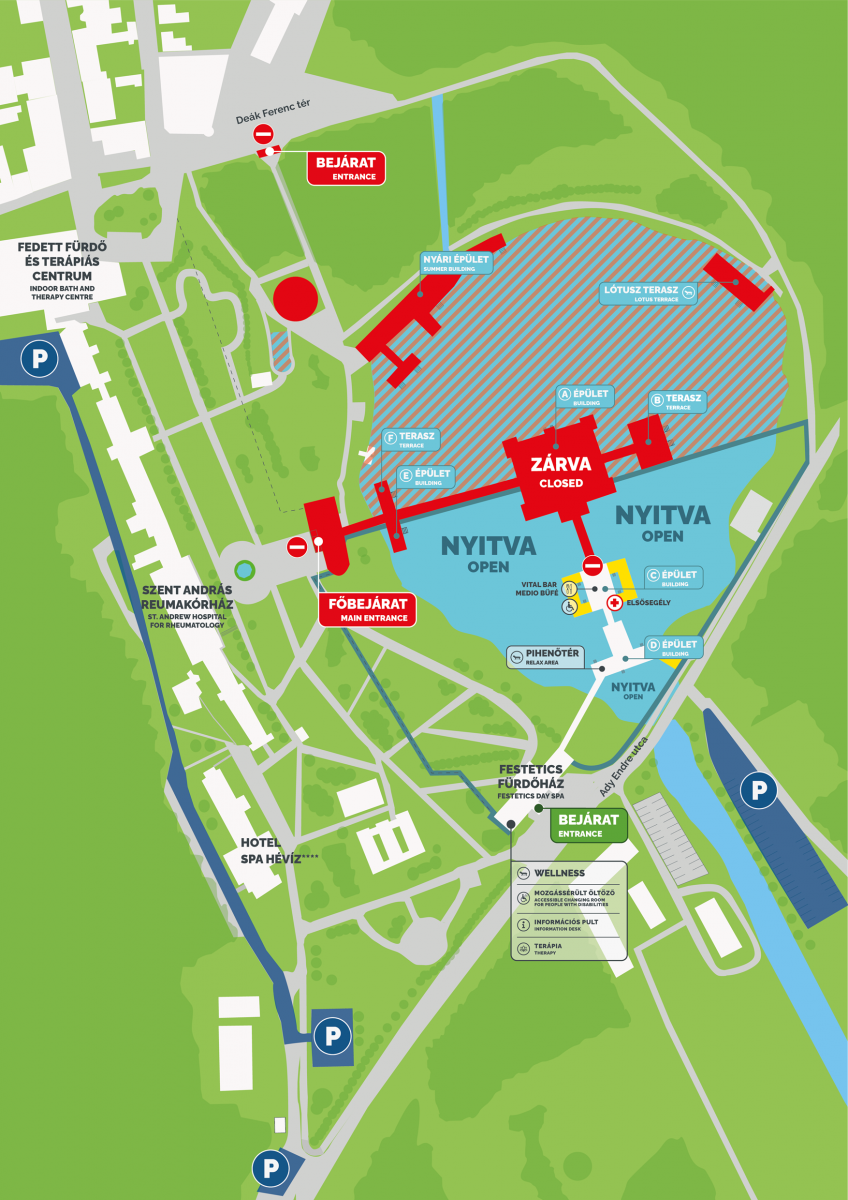
From 3 November 2025, Lake Hévíz can be accessed only via the entrance on Ady Street through the Festetics Day Spa.
Bathing is allowed only outdoors.
• Wellness area (the admission ticket includes the wellness usage fee)
• Vital Bar and Medio Buffet
• Covered rest areas in the section between Festetics Bathhouse and Vital Bar / Medio Buffet (“C” and “D” buildings)
• Outdoor shoreline section between the main entrance and the Festetics Day Spa (seasonally)
A limit is introduced on the accessible territories of the Lake Bath, which determines the simultaneous capacity of the facilities. For up‑to‑date information, please contact the information desk:
E‑mail: spaheviz@spaheviz.hu
Mobile: +36 30 959 1002
• Deák Square entrance
• Central Bathhouse (“A” building and “B” terrace)
• Northern water surface (between the “A” building and the Summer building)
Detailed information about the closure of the central Bathhouse (“A” building and “B” terrace) is available on www.spaheviz.hu.
Due to technical preparation work, phased closures on the water surface and shoreline are expected.
• Patient lift: at the outdoor seating pool (Vital Bar terrace, “C” Building )
Our staff provide assistance with the use of the patient lift.
Yearly opening hours |
|||
| Opening | End of bathing and wellness time | Closing | |
| 2025.10.06. - 2025.10.25. | 9:00 | 17:00 | 17:30 |
| 2025.10.26. - 2026.02.08. | 8:30 | 16:00 | 16:30 |
| 2026.02.09. - 2026.03.29. | 9:00 | 17:00 | 17:30 |
Closing time on 24.12.2025 is at 14:00; on 31.12.2025 at 16:00. Opening time is at 11:00 on 01.01.2026.
Hévíz Lake Bath and Festetics Bathhouse price list
Valid from 03.11.2025 to 31.03.2026
2-hour admission + WELLNESS ACCESS |
|
| Valid only on the day of purchase – entitles to a one-time entry. Includes the use of the wellness area. An additional charge will be levied if the allotted time limit is exceeded. Additional time extension cannot be purchased after the time limit has expired. Admission for children under the age of 6 is free of charge. | |
| 2-hour admission | 3 000 HUF |
| 2-hour admission seniors - Available for individuals over the age of 60. Can be purchased upon prior presentation of a valid photo ID. | 2 500 HUF |
| 2-hour admission students - Available for individuals over the age of 14. Can be purchased upon prior presentation of a valid student card. | 2 500 HUF |
| 2-hour admission children - Available for children aged 6 to 14. | 1 500 HUF |
| 2-hour admission groups - Discounted 2-hour admission - available for groups of 20 people or more, if payed in one sum. | 2500 HUF/Person |
Memberships + WELLNESS ACCESS |
|
| 10-hour membership - Valid for 20 days (can be used on the day of purchase + 19 calendar days) - the pass grants entry twice per day. Includes the use of the wellness area. The deposit is refundable within 5 calendar days after the expiration date. | 13 000 Ft + 2 000 Ft deposit |
| 20-hour membership - Valid for 30 days (can be used on the day of purchase + 29 calendar days) - the pass grants entry twice per day. Includes the use of the wellness area. The deposit is refundable within 5 calendar days after the expiration date. | 23 000 Ft + 2 000 Ft deposit |
Other rates |
|
| + 1 hour extension - Usable for extending the 2-hour admission. Valid once per admission. | 1 500 HUF |
| Additional charge - For exceeding the allotted time limit, payable for every 30 minutes. | 1 000 HUF |
| Cloakroom - Operates seasonally - the fee applies per coat/package. | 300 HUF |
| Safety deposit box - Usage is free of charge. |
2000 HUF deposit |
| Swimring rental - Daily fee. | 700 HUF + 2 000 HUF deposit |
| Sauna towel | 500 HUF |
Online purchased tickets and gift vouchers can be redeemed at the information desk located in the Festetics Day Spa.
Gift vouchers purchased from 1 October 2025, can be redeemed between 1 April 2026 and 31 October 2026.
General information
- The depth of the lake is 2 to 38 m.
• We reserve the right to change prices and opening hours.
• The price of purchased tickets can not be refunded.
• Accepted means of payment: cash (HUF), bank card or SZÉP card.
• By purchasing admission to the lake area, visitors implicitly agree to adhere to the house rules.
• Admission for children under the age of 6 is free.
• Swimring rental is possible only with the purchase of a rental ticket and the payment of a deposit. The Bath refunds the deposit only, if the rented equipment is returned until the end of bathing time, on the day of rental. Payment is possible only in cash (in Hungarian Forint).
• The admission tickets include the use of the wellness area. Wellness and sauna services are available to individuals over 12 years of age only. For reasons of hygiene, one sauna towel is provided for each wellness admission.
• For more information, please contact the information counter at the Festetics Day Spa
12. DO NOT MISS IT!
Last modification: 2022. March. 01. 12:51
Találati relevancia adatok
Tárolt adatok:


On two wheels
Choose an outdoor spot for sports activities whenever it is possible. While you are on holiday, a lake-shore area, the edge of a forest or a park could be the most ideal spot for active recreation.
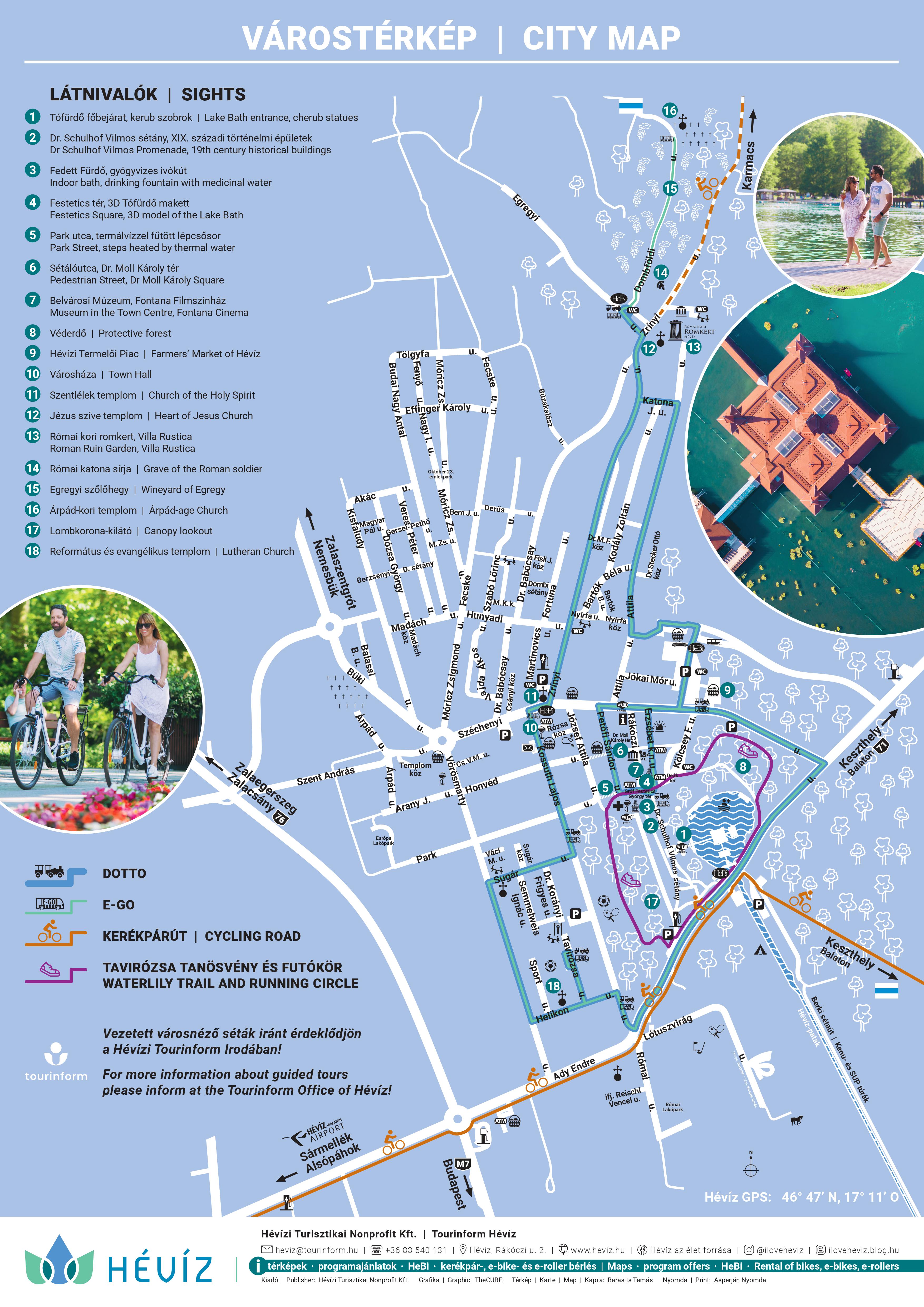
Hévíz and its surroundings provide you with good cycling facilities; there are a number of built cycle tracks and marked cycle routes. While cycling, you can get to know the towns and superb landscapes of the Balaton Highlands, the volcanic hills and the valleys hiding between the shore hills as well as the wildlife of the Kis-Balaton. You can hire a bike in various places, including tourist offices, hotels and even guest houses.
Bicycle and E-bike rent at the Tourinform Office
From January 2021, we await our guests with a whole new set of bicycles, e-bikes!
Prices from 15.05.2025
| 3 hours |
24 hours |
3 or more days |
|
| Classic bicycle |
4 900 Ft | 6 900 Ft | 6 500 Ft/day |
| e-bike - NEUZER |
6 000 Ft | 9 000 Ft | 8 000 Ft/day |
| e-Trekking BIANCHI | 9 000 Ft | 14 000 Ft | 12 500 Ft/day |
| e-MTB fully BIANCHI | 14 000 Ft | 22 000 Ft | 20 000 Ft/day |
/We reserve the right to change./
Free accessories:
- child seat
- bicycle lock
- crash helmet
Accessories for rent:
- phone holder: HUF 1,000 / pc
- side bag: HUF 1,000 / pc
- water bottle holder: HUF 1,000 / pc
- basket: HUF 1,000 / pc
Bike Rental – General Conditions
Pick-up and Return:
Bikes can be collected at the Tourinform Hévíz office and must be returned to the same place no later than 30 minutes before closing time, or stored overnight in a locked place. Rental extension is possible with an extra fee (grace period max. 30 minutes).
Payment:
The rental fee must be paid in advance. Accepted payment methods: cash, bank card, SZÉP card. Payment is made in HUF.
Equipment and Accessories:
Bikes are handed over in proper technical condition. Helmets, child seats, phone holders, baskets, panniers, and bottle holders are available on request. E-bikes are provided fully charged.
Use:
The renter must comply with traffic regulations and use the bike properly. It is forbidden to leave the bike unattended or unlocked. Overnight, it should be stored in a locked or guarded place whenever possible.
Liability:
After collection, all risks are borne by the renter. The renter is financially responsible for any damage, loss, or theft of the bike, as well as for any damages or violations caused with the bike. Any damage must be reported and settled immediately upon return.
Data Protection:
Personal data required for the rental will be processed by Hévízi Turisztikai Nonprofit Kft. in accordance with its privacy policy.
This summary is for informational purposes only. The detailed terms and conditions are set out in the rental agreement signed on site.

Active programmes on the beaches, in the marinas
On several beaches of Lake Balaton you can rent canoes, kayaks, SUP and of course paddle boats. If you want to experience something more challenging, you can also try the water adventure park on the Municipal Beach of Keszthely or the water skiing track on the beach of Vonyarcvashegy. Going on a pleasure cruise is less active but also can be great fun. There are not only scheduled boat services from the Keszthely pier but also themed excursion boats. And if you want to drive a boat yourself, you can hire a small motorboat in the bay.
Kis-Balaton Paddling tours
The Balaton-Uplands National Park organises canoe trips to Diás Island on the Gyöngyös stream during the summer. The group can visit the István Fekete Memorial and Uncle Matula’s Hut, which evokes the atmosphere of the famous Hungarian novel Tüskevár. Advance booking is required for the tours. Guided tours around the Kányavár Island on Kis-Balaton are also available.
Paddling on the River Zala
Paddling on the River Zala for 12 km from Zalaapáti to Zalavár, an easy all-day programme for everyone
Canoeing in winter on the steaming Hévíz Stream
Those who are attracted to extreme conditions can try paddling on the steaming Hévíz Stream from November to March. As protected plants bloom in the stream in the summer and several water birds breed in the reeds along the banks, paddling on the stream is only allowed in the winter with a tour guide. However, it's a fantastic experience, especially if it is snowing. You can have more details about tours at the Hévíz Tourinform Office during the winter season.
From 3 November 2025, Lake Hévíz can be accessed only via the entrance on Ady Street through the Festetics Day Spa.
Bathing is allowed only outdoors.
• Wellness area (the admission ticket includes the wellness usage fee)
• Vital Bar and Medio Buffet
• Covered rest areas in the section between Festetics Bathhouse and Vital Bar / Medio Buffet (“C” and “D” buildings)
• Outdoor shoreline section between the main entrance and the Festetics Day Spa (seasonally)
A limit is introduced on the accessible territories of the Lake Bath, which determines the simultaneous capacity of the facilities. For up‑to‑date information, please contact the information desk:
E‑mail: spaheviz@spaheviz.hu
Mobile: +36 30 959 1002
• Deák Square entrance
• Central Bathhouse (“A” building and “B” terrace)
• Northern water surface (between the “A” building and the Summer building)
Detailed information about the closure of the central Bathhouse (“A” building and “B” terrace) is available on www.spaheviz.hu.
Due to technical preparation work, phased closures on the water surface and shoreline are expected.
• Patient lift: at the outdoor seating pool (Vital Bar terrace, “C” Building )
Our staff provide assistance with the use of the patient lift.
Yearly opening hours |
|||
| Opening | End of bathing and wellness time | Closing | |
| 2025.10.06. - 2025.10.25. | 9:00 | 17:00 | 17:30 |
| 2025.10.26. - 2026.02.08. | 8:30 | 16:00 | 16:30 |
| 2026.02.09. - 2026.03.29. | 9:00 | 17:00 | 17:30 |
Closing time on 24.12.2025 is at 14:00; on 31.12.2025 at 16:00. Opening time is at 11:00 on 01.01.2026.
Hévíz Lake Bath and Festetics Bathhouse price list
Valid from 03.11.2025 to 31.03.2026
2-hour admission + WELLNESS ACCESS |
|
| Valid only on the day of purchase – entitles to a one-time entry. Includes the use of the wellness area. An additional charge will be levied if the allotted time limit is exceeded. Additional time extension cannot be purchased after the time limit has expired. Admission for children under the age of 6 is free of charge. | |
| 2-hour admission | 3 000 HUF |
| 2-hour admission seniors - Available for individuals over the age of 60. Can be purchased upon prior presentation of a valid photo ID. | 2 500 HUF |
| 2-hour admission students - Available for individuals over the age of 14. Can be purchased upon prior presentation of a valid student card. | 2 500 HUF |
| 2-hour admission children - Available for children aged 6 to 14. | 1 500 HUF |
| 2-hour admission groups - Discounted 2-hour admission - available for groups of 20 people or more, if payed in one sum. | 2500 HUF/Person |
Memberships + WELLNESS ACCESS |
|
| 10-hour membership - Valid for 20 days (can be used on the day of purchase + 19 calendar days) - the pass grants entry twice per day. Includes the use of the wellness area. The deposit is refundable within 5 calendar days after the expiration date. | 13 000 Ft + 2 000 Ft deposit |
| 20-hour membership - Valid for 30 days (can be used on the day of purchase + 29 calendar days) - the pass grants entry twice per day. Includes the use of the wellness area. The deposit is refundable within 5 calendar days after the expiration date. | 23 000 Ft + 2 000 Ft deposit |
Other rates |
|
| + 1 hour extension - Usable for extending the 2-hour admission. Valid once per admission. | 1 500 HUF |
| Additional charge - For exceeding the allotted time limit, payable for every 30 minutes. | 1 000 HUF |
| Cloakroom - Operates seasonally - the fee applies per coat/package. | 300 HUF |
| Safety deposit box - Usage is free of charge. |
2000 HUF deposit |
| Swimring rental - Daily fee. | 700 HUF + 2 000 HUF deposit |
| Sauna towel | 500 HUF |
Online purchased tickets and gift vouchers can be redeemed at the information desk located in the Festetics Day Spa.
Gift vouchers purchased from 1 October 2025, can be redeemed between 1 April 2026 and 31 October 2026.
General information
- The depth of the lake is 2 to 38 m.
• We reserve the right to change prices and opening hours.
• The price of purchased tickets can not be refunded.
• Accepted means of payment: cash (HUF), bank card or SZÉP card.
• By purchasing admission to the lake area, visitors implicitly agree to adhere to the house rules.
• Admission for children under the age of 6 is free.
• Swimring rental is possible only with the purchase of a rental ticket and the payment of a deposit. The Bath refunds the deposit only, if the rented equipment is returned until the end of bathing time, on the day of rental. Payment is possible only in cash (in Hungarian Forint).
• The admission tickets include the use of the wellness area. Wellness and sauna services are available to individuals over 12 years of age only. For reasons of hygiene, one sauna towel is provided for each wellness admission.
• For more information, please contact the information counter at the Festetics Day Spa
13. Search Program
Last modification: 2022. February. 14. 11:19

Találati relevancia adatok
Tárolt adatok:
14. Medicinal mud
Last modification: 2019. June. 13. 15:02
Találati relevancia adatok
Tárolt adatok:
15. Drinking cure
Last modification: 2019. June. 13. 14:43
Találati relevancia adatok
Tárolt adatok:
16. Hydrotherapy
Last modification: 2019. June. 13. 14:10
Találati relevancia adatok
Tárolt adatok:
17. Additional elements of the therapy
Last modification: 2019. June. 13. 14:52
Találati relevancia adatok
Tárolt adatok:
18. Places for wine tasting
Last modification: 2019. July. 11. 11:11
Találati relevancia adatok
Tárolt adatok:
Friday 13th did not bring the Borbély Family Winery bad luck.
On 13th February 2015 the Wine of Town Hévíz was chosen for the 8th time, organised by the Hévíz TDM Association.
During the public and professional rating of the jury, the visitors could taste the six best wines. They intended to choose the wine that reflects the atmosphere of town Hévíz and would certainly appeal to the general public. That is why the Borbély Family Winery’s Gabriella Muscat Ottonel ’2014’ of Badacsony was chosen. According to the opinion of the jury it is harmonious, elegant and keepable, it suits well to the atmosphere of the spa town and it could be a worthy representative of Hévíz, since this wine will represent the town at touristic and protocol events in 2015.
The Wine of Town Hévíz 2015 can be purchased in the Tourinform Office in Hévíz and will be available at most of the restaurants and bars of Hévíz from the end of February 2015.
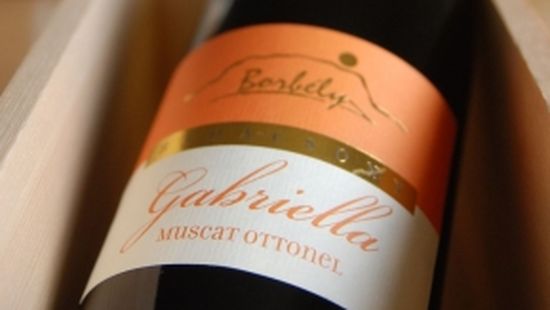
Find our wines in the Tourinform Office, restaurants, at your accommodation or in souvenir shops, and add to the good reputation of our town!
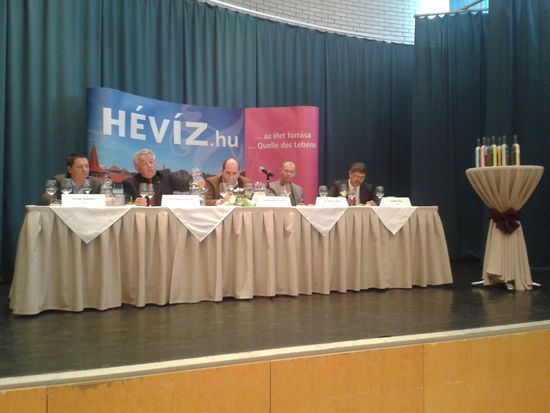
Welschriesling of Rezi of the vintage 2013 has become the Wine of Town Hévíz
The 7th Wine of Town Hévíz Selection took place at 1 pm on 23rd April 2014 in the Assembly hall of the Local Government of Hévíz. 10 wineries from County Zala and the Balaton Wine Region were invited. All of them could enter with not more than two types of dry white wine produced in the Wine Region.
19. Recipe tips from Hévíz
Last modification: 2019. June. 12. 14:13
Találati relevancia adatok
Tárolt adatok:
20. Healing lake, heailing water
Last modification: 2019. June. 13. 15:08