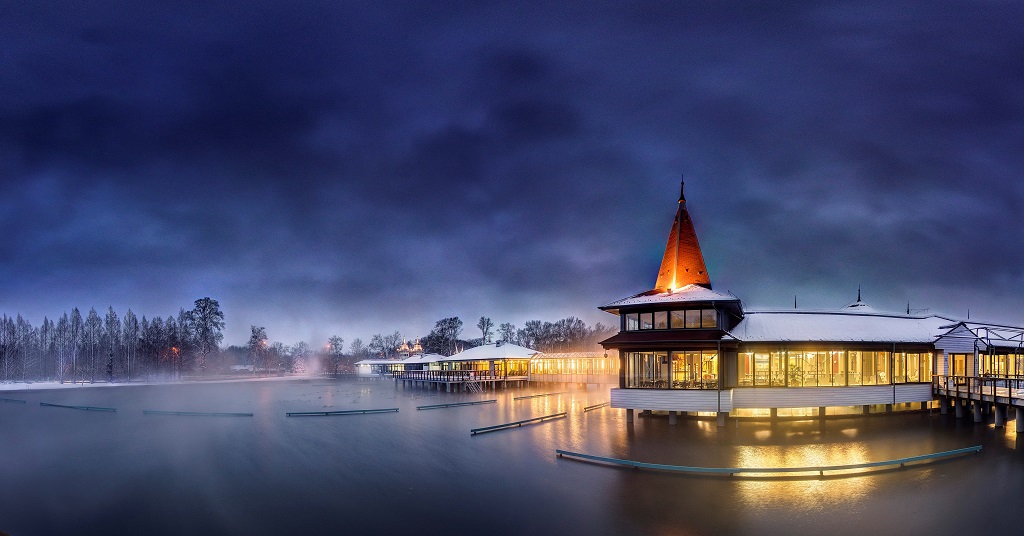
Lake Hévíz is the world’s largest biologically-active natural thermal lake, which is able to refresh body and soul alike.
The source of the 4.4 ha water surface lake, rich in sulphur, and minerals can be found 38 metres deep in the cave, which due to its high well capacity completely changes in every 72 hours. The water of Lake Hévíz contains an equal proportion of dissolved and gaseous substances, thus unifying the favourable characteristics of thermal waters rich in carbonic acid, sulphur, calcium, magnesium, hydrogen carbonate.
Lake Echo of New Zealand is larger and its water is warmer, but it cannot be compared to the particularities of the Hungarian lake as it is not suitable for bathing and cannot be used for medical purposes.

The history of Hévíz Lake
The origins of Lake Hévíz go back to the ancient times when Lake Balaton and the basalt mountains around the lake were formulated. At the end of the Pannon-era volcanoes disrupted the layout of the Trans-Danube region. The healing power of the water was already known to our ancestors. The first signs of post-volcanic activity were the spring of heat sources, as was the eruption of “Ancient Hévíz”.
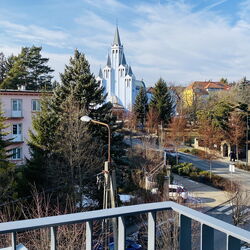
Archaeological excavations prove that this area was inhabited even at the end of the Stone Age. The art relic church on Egregy hill was built during the reign of the Árpád-dynasty, which uniquely preserved the reminiscence of the era.
Legends are connected with miracles; nevertheless, Hévíz is a miracle in itself.
 According to an ancient legend on the origin and healing effect of the lake, the Holy Virgin wrung a spring by the appealing prayer of a Christian nurse. The nurse wanted to heal an invalid child. The hot water of the lake breaking out from the depth and the steaming mud completely cured the weak child.
The legend stems from the Roman age and the mentioned child was definitely the East Roman emperor, Flavius Theodosius, who declared Christianity the official religion in his own empire in 391. The spring has been feeding the world-wide unique Lake of Hévíz ever since.
According to another legend once upon a time the commander of Csobánc castle fell in love with the daughter of Tátika castle’s castellan. The commander had often seen the girl leaning on her elbow at the towers of the castle. The two castellans were enemies. The commander of Csobánc castle went to fight for the girl. It was only revealed that the girl was lame in both feet when he won the fight. As an old woman suggested, after the wedding they built a house for themselves on the shores of Hévíz Lake so that the young lady could often dip her legs into the warm water. A few weeks later the lame feet were healed and the lovers lived happily ever after.
It happened even earlier than our great-great-grandfathers’ times that a shepherd grazed his stock in the surrounding hills and herded them beside the moor to drink. Suddenly he saw that one of his footsore cow kept disappearing in the shrubbery and just stood there. As he went closer he felt that the water was much warmer there. After that he came to bath his sore feet in the steaming water several times. Not even a lunistice passed and the miracle happened: his foot pain completely disappeared. This took wind in the estate and the shrewd landowner enclosed the warm water. This is how the thermal lake came into being for the happiness of many sick people.
Did you heard about the legendary cherubs?
 The main entrance of the lake is guarded by two cherubs, which were made on behalf of the Festetics family at the turn of the 19th and 20th century and they are very similar to the Zsolnay family’s cherubs in Pécs. The dragon made of a lion and an eagle can also be found on Hévíz’s official coat of arms.
The cherubs served the gods in the mythology of the ancient Semite folks. They stood in front of the gates and kept away the demons. Their images were engraved in the stones of kings’ palace gates or church gates, most likely that is why the Festetics family had them made as well.
According to the legend, if someone walks through between two cherubs without love in the heart, the cherubs start speaking. According to another storyteller not the cherubs but the copper rooster placed on one of the towers of the baths starts speaking, if someone leaves the town without love. But there has never been a precedent for this.
Did you know, that
- the water temperature may reach 23-25 °C in winter and 33-36 °C in summer? The water of the lake is in a constant move. On the one hand, it is moving from left to the right, and on the other hand, warm water moves upwards while cold water goes downwards. This two-way flow keeps the water of the lake in a constant move, thus leaving a special massaging effect on the human skin.
- in winter it provides a spectacular and unique experience when the condensed steam forms a steam cap on the top of the lake surface? This “cap” prevents water from cooling down, and at the same time a natural inhalatorium is formed. Hydrogen sulphide is released into the air, which have medical effects on the exhausted vocal cords when inhaled.
- according to the memoires from the Roman era, the oldest and most famous thermal bath in Hungary can take pride in a history of over 2,000 years?
- Lake Hévíz, together with the volcanic hills of the Tapolca basin and those of the Tihany peninsula were included in the recommendation list of the World Heritage National Hungarian Committee in January 2003?